Within the last few weeks, a second company—Apple, joining Nvidia[1]—impressively eclipsed a $5 trillion valuation[2]. That occurrence raised two questions: Can these companies continue to grow at this pace? And, most importantly, does it matter to long-term investors like us?
The existence of two $5 trillion companies is an extension of the market concentration issue that pundits have described as a significant risk for nearly a decade now. This headline concern goes back at least to 2018, when many investors and media outlets[3] warned that the technology sector was approaching levels last seen near the height of the tech bubble.
Back then, Apple was on the verge of becoming the first company to reach a $1 trillion valuation. But since that time, we’ve expanded to fifteen global trillion-dollar companies[4], the market has grown significantly more concentrated[5], and the stock market as a whole has nearly tripled[6]. Yes, tripled. Suffice it to say that it’s been an incredible run.
We bring those old headline risks up not to criticize any particular author, but to illustrate how much markets have changed, how long they can surprise investors, and to use them as a jumping-off point to discuss how large companies can grow and what we should do about it all.
Perhaps the only thing more impressive than how quickly Apple and Nvidia grew from $1 trillion to $5 trillion—eight years[2][3], and an incredible two-and-a-half years[7], respectively—is their sheer scale, which is almost unfathomable.
We’ll stick with describing Apple here[1] since its products are more ubiquitous than those of many other companies. Anyhow, in 2024, just Apple’s AirPods product generated more than $18 billion in revenue. For perspective, that was more than the total revenue of companies like Spotify, Nintendo, eBay, and Airbnb[8].
In other words, these are not normal companies. And their size makes their impact on the stock market equally impressive. As an example of what we mean: Shortly after crossing the $5 trillion threshold, Apple’s stock dropped roughly 10%, reducing its market capitalization by more than $500 billion[9]. Once again, for perspective, that decline was larger than the entire market value of Costco—the 32nd largest publicly traded company in the world[4].
Which raises the question, given how large these companies already are, how much bigger can they get? We’re confident that nobody knows anything for sure, but Warren Buffett[10] once said that,
“Size is the anchor of performance.”
That perspective makes logical sense given that there are only so many products large enough to materially affect a company of that size and scale.
And, with regard to their stock, just mathematically speaking, if a $5 trillion company grew by 10% annually—the long-term average return of the market—it would become a $33 trillion company within 20 years[11]. You can decide if that seems plausible, but at some point, Buffett is probably right.
Does that mean we should be worried, especially given that their dominance is regularly presented as one of the greatest risks facing investors? To be sure, that concern is justified. Overweighting a portfolio too heavily in these companies—or any companies—can pose a significant risk, so we should avoid that risk at all costs.
And so, we do, through prudent diversification. The question of how large these companies might become is undoubtedly interesting and makes for great TV, but the reason we diversify across company size, sector, and geography is that it frees us from needing a definitive answer about how much larger today’s winners can become. If the winners keep winning, that’s great; we continue to benefit. If leadership rotates, that is fine too, because we own the next winners as well.
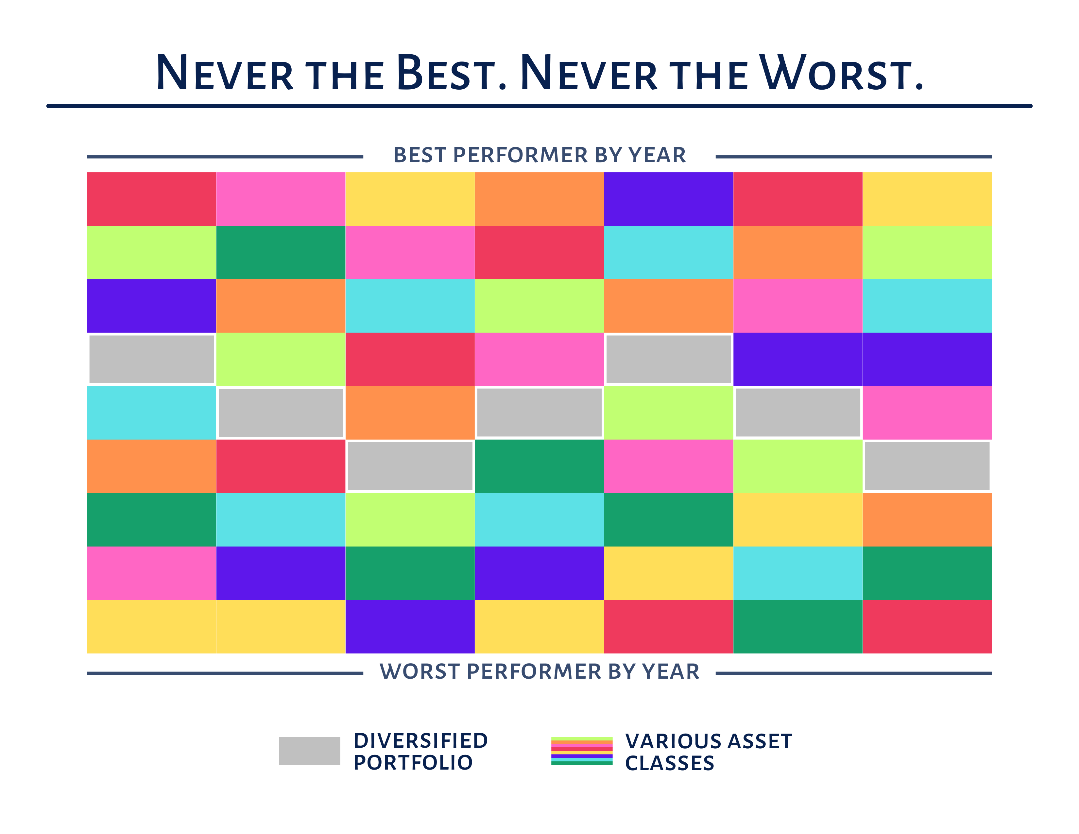
In other words, diversification allows us to largely ignore the predictions, debates, and noise surrounding any individual company. Rather than betting that a handful of businesses will dominate forever—or that their success must soon end—we are placing a broader bet on the continued progress and wealth creation of our increasingly global economy.
By adequately diversifying, we are trusting that a rising tide will continue lifting many boats, even if we can’t know in advance which boats will rise the fastest.
If this note raises any questions or concerns, please reach out. As always, stay the course.
- [1] This is not a recommendation to buy or sell this, or any other security. I’m using them as an illustrative jumping-off point.
- [2] Reuters
- [3] CFA Institute
- [4] Companies by Market Cap
- [5] J.P. Morgan
- [6] St. Louis Fed
- [7] Reuters ($1T); Reuters ($5T)
- [8] PC Mag
- [9] Reuters
- [10] 2014 Shareholder Meeting via GuruFocus
- [11] Compound Interest Calculator

*Material created by Money Visuals, LLC, an independent third party not affiliated with Raymond James.
Any opinions are those of the author and not necessarily those of Raymond James. Expressions of opinion are as of this date and are subject to change without notice. There is no guarantee that these statements, opinions, or forecasts provided herein will prove to be correct. Investing involves risk and you may incur a profit or loss regardless of strategy selected. Every investor’s situation is unique and you should consider your investment goals, risk tolerance and time horizon before making any investment. Past performance is not indicative of future results. This material is being provided for information purposes only and is not a complete description, nor is it a recommendation. The information has been obtained from sources considered to be reliable, but we do not guarantee that the foregoing material is accurate or complete.